Last updated: 22 October 2026
A baby arrives, and within a week three relatives have asked, "Beta, Sukanya khata khola?" and a colleague has forwarded a reel about "NPS for kids". Both sound like the responsible thing to do. Both lock money away for a very long time. But they're built for very different jobs, and picking the wrong one is like packing a tiffin for a flight that already serves dinner. Let's sort it out.
In short (as of 22 October 2026): Sukanya Samriddhi is a government-backed savings account only for a girl child below 10. It pays 8.2% a year for October to December 2026 and matures 21 years after opening. NPS Vatsalya is a PFRDA-regulated, market-linked pension account for any child under 18. Sukanya suits education and marriage goals; NPS Vatsalya gives your child a head start on retirement.
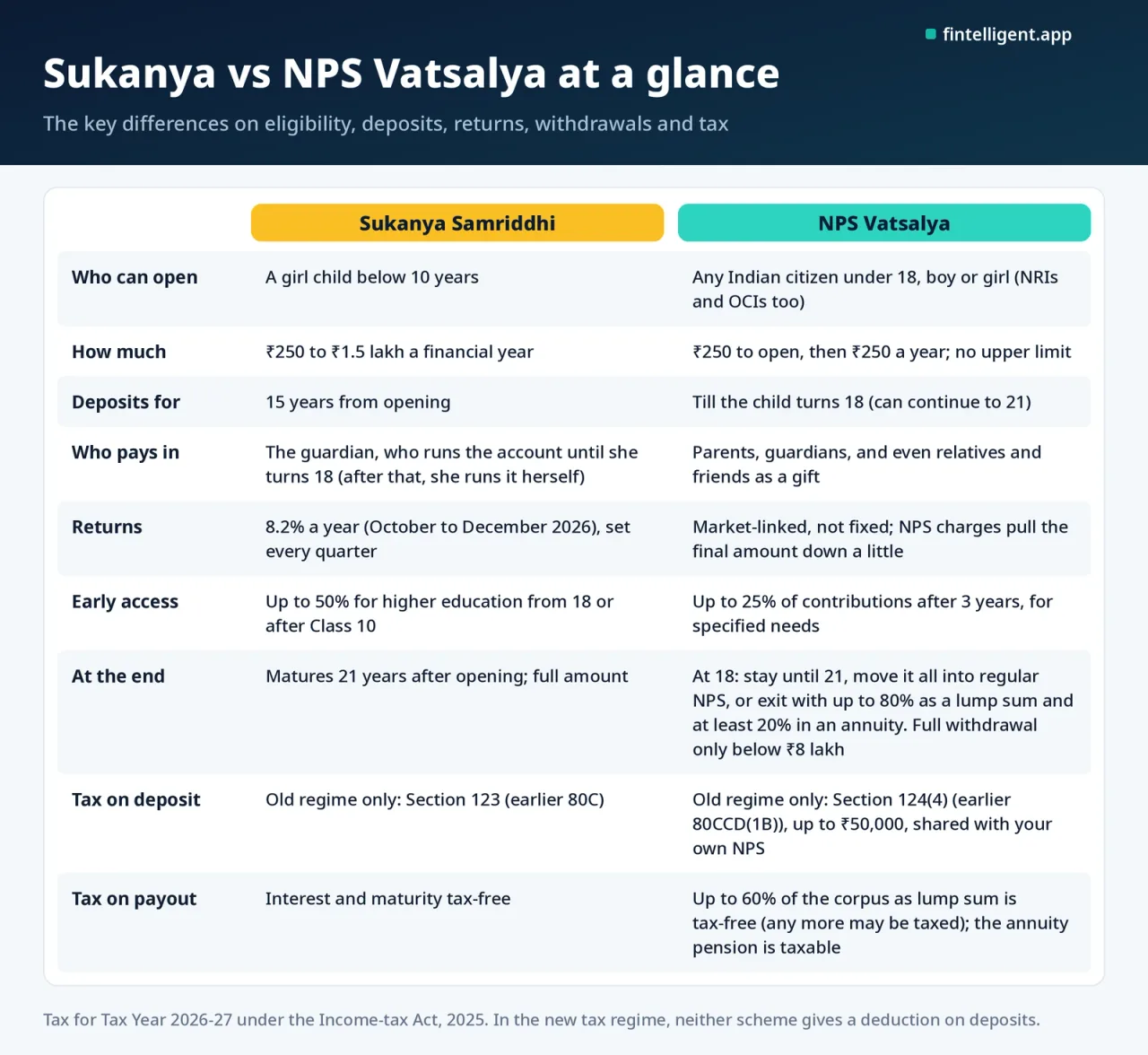
NPS Vatsalya vs Sukanya Samriddhi at a glance
- Sukanya Samriddhi Account (SSA/SSY): a government-backed small savings account, only for a girl child, with an interest rate the government sets every quarter. Right now it's 8.2% a year (October to December 2026).
- NPS Vatsalya: a version of the National Pension System for any child under 18, regulated by PFRDA (the pension regulator). Your money goes into a mix of equity, bonds and government securities, so returns are market-linked, not fixed.
| Sukanya Samriddhi (SSY) | NPS Vatsalya | |
|---|---|---|
| Who it's for | Girl child below 10 | Any Indian citizen under 18 (NRIs and OCIs too) |
| Run by | Government small savings scheme | National Pension System, regulated by PFRDA |
| Returns | 8.2% a year (October to December 2026), reviewed every quarter | Market-linked, not fixed |
| Deposits | ₹250 to ₹1.5 lakh a financial year, for 15 years | ₹250 to open, then ₹250 a year; no upper limit |
| Money before the end | Up to 50% for higher education after 18 or Class 10, capped at actual fees | Up to 25% of contributions after 3 years, for education, specified illnesses or disability |
| End point | Matures 21 years after opening | At 18: move to NPS, take up to 80% (rest to an annuity), or 100% if below ₹8 lakh |
| Deduction (old regime) | Section 123, within ₹1.5 lakh | Section 124(4), up to ₹50,000 shared with your own NPS |
| Deduction (new regime) | None | None |
| Tax on payout | Interest and maturity tax-free | Up to 60% lump sum tax-free; annuity pension taxable |
Think of Sukanya as a pressure cooker with a known number of whistles: you know roughly what comes out. NPS Vatsalya is more like slow-cooking biryani: it can turn out richer, but you don't get a guaranteed result.
Who can open Sukanya Samriddhi and NPS Vatsalya?
Sukanya Samriddhi
- For a girl child below 10 years of age.
- Opened by a parent or legal guardian at a post office or an authorised bank.
- One account per girl, and a maximum of two per family (the rules allow an extra one for twins or triplets).
NPS Vatsalya
- For any Indian citizen under 18, boy or girl. NRIs and OCIs under 18 can join too.
- Opened by a parent or guardian through an NPS service provider (a Point of Presence, such as most big banks, India Post or a pension fund), or online through eNPS or your bank's NPS service. The CRA (record-keeper) apps are for checking and managing the account once it's open.
- A new account can't be opened once the child turns 18.
So if you have a son, or a daughter who is already 10 or older, the choice is made for you: only NPS Vatsalya is open to you.
Minimum and maximum deposit: SSY vs NPS Vatsalya
| Sukanya Samriddhi | NPS Vatsalya | |
|---|---|---|
| Minimum | ₹250 a financial year | ₹250 to open, then ₹250 a year |
| Maximum | ₹1.5 lakh a financial year | No upper limit |
| For how long | Deposits for 15 years from opening | Till the child turns 18 (can continue to 21) |
| Who can deposit | Guardian | Parents, guardians, and even relatives and friends as a gift |
The "relatives can gift into it" bit of NPS Vatsalya is genuinely handy. Instead of the fifth silver glass at the naamkaran, Mamu can just send ₹2,000 to the account.
Returns: SSY's 8.2% vs NPS Vatsalya's market-linked growth
Sukanya Samriddhi pays 8.2% a year for October to December 2026. The government reviews the rate every quarter, and it has stayed at 8.2% for a while, but it can go up or down in future. Interest is worked out every month on the lowest balance between the 5th and the end of the month, and added to the account once a year. (Small tip: deposit before the 5th of the month so that month's interest counts.)
NPS Vatsalya has no fixed rate. Each pension fund decides the mix of investments under PFRDA rules. Equity can be up to 75% under the standard pattern, and pension funds may even design schemes with more equity. More equity means bigger ups and downs along the way, but over 18 years it has historically had a better chance of beating fixed rates. No guarantees, though.
₹5,000 a month for a newborn: which grows more?
Let's say Priya and Arjun's daughter is born this year, and they decide to save ₹60,000 a year (about ₹5,000 a month) for her.
Assumptions: the ₹60,000 is paid in one go at the start of each financial year (before 5 April), for 15 years, so the total paid in is ₹9 lakh. The Sukanya rate stays at 8.2% for the whole period (it won't be exactly that in real life). The NPS returns of 8%, 10% and 12% a year are just illustrations, not predictions, and the NPS figures ignore charges. NPS Vatsalya carries the usual NPS charges, such as the pension fund's investment management fee (0.04% to 0.12% a year), the service provider's 0.20% a year of the balance plus a one-time ₹200, and the record-keeper's yearly account maintenance charge, so real values would be a little lower.
| Scheme | Assumed return | Value when she turns 18 | Value at 21 |
|---|---|---|---|
| Sukanya Samriddhi | 8.2% (steady) | about ₹22.7 lakh (mostly locked; up to 50% for education) | about ₹28.7 lakh (matures) |
| NPS Vatsalya | 8% a year | about ₹22.2 lakh | |
| NPS Vatsalya | 10% a year | about ₹27.9 lakh | |
| NPS Vatsalya | 12% a year | about ₹35.2 lakh |

Fintelligent
Two things jump out:
- At 10% a year, NPS Vatsalya at 18 is roughly where Sukanya lands at 21. At 8%, it's a bit behind; at 12%, it's well ahead.
- If she exits at 18 with ₹8 lakh or more, the NPS number isn't fully hers to spend: at least 20% has to go into an annuity. She can also skip the exit and move it all into regular NPS. That's the next section.
Withdrawal rules: SSY maturity at 21 vs NPS Vatsalya exit at 18
Sukanya Samriddhi
- For higher education: once she turns 18 or passes Class 10 (whichever comes first), you can withdraw up to 50% of the balance as it stood at the end of the previous financial year. You need an admission offer or fee slip, the amount is capped at the actual fees and charges it shows, and you can take it in one go or once a year for up to five years.
- For marriage: the account can be closed early if she's at least 18, from one month before the wedding up to three months after.
- Maturity: the account matures 21 years after it was opened, and she gets the full amount.
NPS Vatsalya
- Partial withdrawals: after 3 years of opening, you can take out up to 25% of the contributions (not the returns) for her education, treatment of specified illnesses, or disability of more than 75%. You get two withdrawals before 18 and two more between 18 and 21.
- At 18: she completes her own KYC and then picks one of three paths:
- move the whole amount into a regular NPS account and keep going for retirement,
- take up to 80% as a lump sum and use the rest (at least 20%) to buy an annuity (a monthly pension plan), or
- take 100% out only if the total is below ₹8 lakh.
- If she completes her KYC but doesn't pick an option by 21, the account moves into a higher-equity NPS scheme of the same pension fund automatically. If her KYC still isn't done by 21, the account becomes dormant.
So in our 10% example, if she exits at 18 she could take out about ₹22.3 lakh (80%) and at least about ₹5.6 lakh would have to go into an annuity. That annuity money isn't available for college fees. NPS Vatsalya is, at heart, a pension product that starts early. Sukanya is a goal-savings product for education and marriage.
Tax benefits: Section 123 vs Section 124(4)
From 1 April 2026, India's new Income-tax Act, 2025 applies, so the old section numbers have changed. Here's the current picture for Tax Year 2026-27:
| Sukanya Samriddhi | NPS Vatsalya | |
|---|---|---|
| Deduction on deposit (old regime) | Yes, under Section 123 (earlier 80C), within the overall ₹1.5 lakh limit | Yes, up to ₹50,000 under Section 124(4) (earlier 80CCD(1B)), but this ₹50,000 is shared with your own NPS contribution, not extra |
| Deduction on deposit (new regime) | None | None |
| Interest/growth | Tax-free | Not taxed while it stays invested |
| Withdrawals | Interest and maturity tax-free in both regimes | Partial withdrawals tax-free; at exit, up to 60% of the corpus as lump sum is tax-free; the part used for an annuity isn't taxed, but the pension it pays later is taxable |
A few plain-English points:
- If you're in the new tax regime (it's now the default), neither scheme gives you a deduction when you deposit. Sukanya's interest and maturity are still completely tax-free, though.
- If you already put ₹50,000 into your own NPS for the extra deduction, adding NPS Vatsalya won't get you any more deduction. The ₹50,000 limit is a combined one, not per child.
- The Section 124(4) deduction is only for the parent's or guardian's own contribution to the child's account. Gifts from relatives and friends don't give them a deduction.
- In NPS Vatsalya, the tax-free part of the exit lump sum is 60% of the corpus. If she takes the full 80% lump sum, the extra 20% may be taxed.
- If the corpus is under ₹8 lakh and she takes 100% out, the same 60% limit applies, so the remaining 40% may be taxed.
NPS Vatsalya or Sukanya Samriddhi: which should you pick?
Fintelligent
Pick Sukanya Samriddhi if:
- you have a daughter under 10,
- the goal is her education or marriage,
- you want a known, government-backed rate and tax-free maturity.
Pick NPS Vatsalya if:
- you have a son, or a daughter who's 10 or older,
- you're happy with market ups and downs for possibly higher long-term growth,
- the main idea is to give your child a head start on retirement, not to fund college.
Doing both? Plenty of families do. A common approach: Sukanya for her education goal, and a smaller NPS Vatsalya amount as a long-term "pension seed" that relatives can top up on birthdays.
And remember: neither of these replaces your own emergency fund or your own retirement savings. Kids can take an education loan; you can't take a retirement loan. Sort your own basics first.
Common myths about SSY and NPS Vatsalya
- "Sukanya is only for girls, so NPS Vatsalya is the boys' version." Not quite. NPS Vatsalya is open to girls too, and it's a pension product, not a savings account.
- "I can take all the NPS Vatsalya money at 18." Only if the total is under ₹8 lakh. If she exits with more, at least 20% goes into an annuity. She can also move the whole amount into regular NPS instead.
- "Sukanya's 8.2% is locked in for 21 years." No. The rate can change every quarter, and your whole balance earns whatever the current rate is.
- "I missed a year's Sukanya deposit, so the account is dead." It can be revived by paying the missed minimum deposits plus a small penalty of ₹50 for each year missed.
The bottom line
Sukanya Samriddhi is a safe, steady, tax-free way to build a fund for your daughter's education and marriage. NPS Vatsalya is a market-linked way to start your child's retirement savings early, with limited access before 18 and an annuity rule at exit. If the goal is college fees, Sukanya (or a goal-based SIP) usually fits better. If the goal is giving your child a 40-year head start on compounding, NPS Vatsalya is the tool for that.
Related reads
- EPF vs PPF vs NPS: which is best for you?
- PPF vs FD: which is better for your savings?
- Old tax regime vs new tax regime: which one should you pick?
- What is ELSS? The tax-saving mutual fund, explained simply
- What is SIP? Meaning, how it works and examples
- What is an emergency fund? How much you need in India
NPS Vatsalya returns are market-linked and not guaranteed. Past performance doesn't promise future returns. The worked example uses assumed rates for illustration only and is not investment or tax advice.
Sources (checked 22 October 2026): Ministry of Finance, Department of Economic Affairs Office Memorandum No. 1/4/2019-NS dated 30 September 2026, circulated by India Post as SB Order No. 12/2026 (small savings rates for 1 October to 31 December 2026 unchanged from July–September 2026; Sukanya Samriddhi 8.2%); India Post, Sukanya Samriddhi Account Scheme, 2019 (eligibility below 10 years, ₹250 minimum and ₹1.5 lakh maximum a year, 15-year deposit period, interest on lowest balance between the 5th and month-end credited yearly, 50% withdrawal for education after 18 or Class 10, capped at the actual fee requirement, closure for marriage after 18, maturity at 21 years); PFRDA, NPS Vatsalya Scheme Guidelines 2025, (opening channels, KYC at 18 and dormancy, options at 18 and 21), effective 23 February 2026 per PFRDA circular dated 27 February 2026; PFRDA, NPS Vatsalya page and NPS Vatsalya FAQs (updated 16 June 2026) (₹250 minimum, no maximum; asset allocation; charges; 25% partial withdrawals after 3 years; options at 18 including the ₹8 lakh full-withdrawal limit and 80/20 rule; tax treatment under Section 124(4), Schedule II and Schedule III and Section 124(9) of the Income-tax Act, 2025); Income Tax Department, Income-tax Act, 2025 as amended by the Finance Act, 2026 and Schedule XV (Section 123 deduction up to ₹1.5 lakh, old regime only; new regime under Section 202).